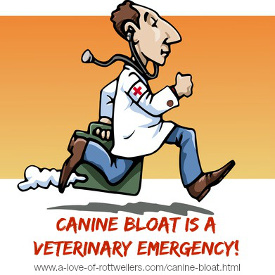
Dog bloat or canine bloat (also known as Gastric Torsion or Gastric Dilatation Volvulus – GDV) is an extremely serious and life-threatening problem.
In This Article You Will Read About
What do You need to Know About Dog Bloat?
It usually appears suddenly and progresses very quickly – often with tragically fatal results.
Bloat tends to strike large and extra-large deep-chested dogs, such as Rottweilers, Great Danes, or Irish Wolfhounds. The prevalence in medium and small-breed dogs is minimal.
However, no breed is immune to the disease.
Knowing how to recognize the symptoms of bloat and knowing what to do next could literally mean the difference between life and death for your dog!
Perhaps you think this sounds a bit melodramatic or that I’m exaggerating. Trust me, I’m not.
Bloat is one of the most dangerous acute health conditions your pet can develop – affected dogs can die within hours.
How quickly you recognize the problem and get the right help for your dog is the biggest factor in determining whether or not the pup survives.
What Exactly Is Dog Bloat?
Basically what happens in dog bloat is that the dog’s stomach becomes distended, or swollen, because of the too much gas building up inside of it.
The distended stomach then puts pressure on the diaphragm and other organs, including the heart. As a result, the blood pressure drops, and the blood flow is restricted or cut off in some of the organs.
This alone can cause the dog to go into shock, or cause cell death in the stomach/digestive system. But it gets worse.
In most cases, the stomach then twists or rotates on itself, closing off the connection between the esophagus and the stomach and between the stomach and the intestines.
This is called a complete volvulus. There is water and gas trapped inside the stomach with no way out, and the gas keeps increasing its volume.
What does Dog Bloat mean?
Actually the name ‘Gastric Dilatation Volvulus’ describes it perfectly….
- GASTRIC – meaning ‘of the stomach’
- DILATATION – meaning ‘to become wider’ or to ‘distend’
- VOLVULUS – meaning ‘abnormal twisting of the esophagus and intestine’
If canine bloat is left untreated there are several potentially fatal results, including a ruptured stomach, irreversible cell damage, shock or cardiac arrest.
What’s even more frightening is that all this happens within the space of a few hours.
Although prompt treatment gives your dog his best shot at making a full recovery, even with immediate treatment, around 25% of all dogs who ‘bloat’ may die.
That’s how dangerous this condition is!
What Causes Bloat in Dogs?
Although large and giant-sized breeds are considered to be ‘high risk’ in terms of gastric torsion, any dog of any breed can be affected. Several things can trigger gastric dilatation-volvulus.
The most common risk factors that veterinarians and researchers have identified in dogs are:
- Being a large, extra-large, or giant breed dog
- Having a ‘deep’ chest (ex. Great Danes, Irish Wolfhounds, Setters, Rottweilers, and Saint Bernards, etc.)
- A ‘family history of bloat – it’s believed that there is an inherited risk for the condition
- Being 7 years old and older
- Being male
- Being anxious, aggressive, fearful, nervous, or excitable by nature
- Experiencing a lot of stress
- Dogs that eat too much and/or too fast (practically ‘inhaling’ their food)
- Exercising vigorously either right before or right after eating
- Eating one big meal per day rather than 2 smaller ones.
- An inadequate or inappropriate diet – ex poor quality foods or food with a very high grain (or carbohydrate) content.
- Drinking a lot of water right before or right after eating
The more ‘risk factors there are for a dog – the greater the chances of developing bloat at some point are. If you identify your dog as a risky candidate it’s important to keep a close eye on him and be aware of the symptoms of bloat in dogs.
Risk for Rottweilers and other breeds
Rottweilers are a large breed, so they definitely have that risk factor. However, they are way down the list of breeds at risk (spot number 23 to be exact and with only a 1.1% greater risk of developing bloat than your average, healthy mixed breed).
So, don’t panic and assume that your Rottie is at high risk of dog bloat, but do be aware that it exists, learn how to recognize the symptoms, and realize that you need to act fast should the worst happen.
For owners of other large or giant breeds, here’s a quick run-down of the Top 10 breeds who are at the highest risk of bloat/torsion (and their risk factor by %), according to a study done by the Purdue University, School of Veterinary Medicine.
1. Great Dane 41.4
2. Saint Bernard 21.8
3. Weimaraner 19.3
4. Irish Setter 14.2
5. Gordon Setter 12.3
6.Standard Poodle 8.8
7. Basset Hound 5.9
8. Doberman Pinscher 5.5
9. Old English Sheepdog 4.8
10. German Shorthaird Pointer 4.6
Other brees at risk include (but aren’t limited to) Newfoundland, GSD, Boxer, Labrador (and Golden) Retrievers, Miniature Poodle and Dachshund.
Dog Bloat Symptoms
When dog bloat strikes, you have a very short ‘window’ of time in which to get your dog the help he needs. That means that it’s absolutely vital that you know what the symptoms of bloat may look like.
Unfortunately, there’s no one-sized picture of a dog experiencing bloat. There are several symptoms that are usually seen and every owner must be familiar with them.
If your dog shows any of the ones we are about to describe, he could be in serious trouble.
Here are the most common symptoms of bloat in dogs:
- Your dog will be in a lot of pain, and this may show up as continuous restlessness, pacing, whining, panting, or drooling
- Repeated attempts at retching or vomiting (without actually being able to bring up more than foam/mucus)
- Constipation-type symptoms and your dog may try to poop but be unable to. This also includes scooting on the floor
- An inability to get comfortable or to lie down – concerning the first point above
- A distended or swollen stomach – it may be visible, but not always
- Eventually, your dog may have difficulty breathing, walking, or even standing
If you notice any of these symptoms, don’t waste a second wondering what to do. Get your dog to an emergency veterinary clinic or hospital IMMEDIATELY.
Minutes, even seconds, count here.
Dog Bloat Timeline
The initial stage is when the dog only has a gas-filled stomach but otherwise acts normal. At this point, you shouldn’t panic. Give your dog some antacids, in case your vet agrees, and the problem is likely to get solved without the development of volvulus.
When gas accumulates and the stomach can’t empty the dog feels slight discomfort and enters the first phase of GDV. In the first phase, the stomach dilates and twists.
You can expect your dog to start pacing and become restless and anxious. They usually start vomiting and salivating. When you see this and suspect volvulus your dog needs to get to the hospital without further delay.
There will be enough time for the pup to recover if you act fast during the first phase.
The second phase doesn’t guarantee a full recovery because some of the stomach tissue is damaged beyond repair. At this point, the dogs are very restless and will whine.
A typical appearance is a dog with legs put apart, head hung down, and swollen abdomen. He will try to vomit every 2-3 minutes and copiously salivate. The dog’s gums have dark discoloration.
You must tell someone to inform the vet to get prepared for surgery and that you are on your way whenever you might suspect your dog is at phase two.
Entering the third phase the dog can stand on his legs anymore. His temperature significantly drops, the breathing becomes shallow and the gums are either blue or white.
Unfortunately, it’s hard for a dog to recover from this phase, but not completely impossible.
The time between the phases can vary from one dog to another. It can take minutes to hours from one phase to another.
The prognosis for GDV is directly linked to the phase the dog is admitted to the vet hospital at.
How to Treat Bloat in Dogs
At the first sign of bloat, your dog needs immediate veterinary attention. If it’s after-hours, go to the nearest emergency pet hospital.
There is no time for a wait-and-see attitude when you’re faced with a dog that may have bloat!
Veterinary treatment depends on whether your dog has experienced dilatation (severely distended stomach which puts pressure on other organs) or both dilatation and volvulus (distended stomach plus twisted/rotated esophagus and intestine).
Only a professional can make an accurate diagnosis as to which situation your dog is in. The goal of the initial treatment is to relieve the pressure in the stomach by removing excess gas. A couple of methods are used to release the gas and put the pressure under control.
The vet can intubate the stomach (put a tube in) through the mouth or punctuate the stomach through the abdominal wall with a special needle called a trocar. In both cases, the dog is put under general anesthesia.
In addition fluids and medications (possibly antibiotics or painkillers) are given by intravenous route to the animal.
Once the dog is stable, surgery is usually performed to return the stomach to the correct position.
If there is damage to the stomach some parts or the organ are taken out. The spleen is especially sensitive in case of bloat and vet surgeons remove it completely in some cases.
How to Prevent Bloat in Dogs
While there’s no sure-fire way to prevent your dog from developing bloat, there are some things that you can do to help minimize the risks.
Although you can’t (and won’t want to) change your dogs’ breed, genetic makeup, size, or age, you can make sure that you are avoiding some of the environmental/behavioral risk factors mentioned above.
Dog Bloat Home Remedy
Despite what you might read on the internet, or on forums, there is no effective home remedy for canine bloat once it appears and you should seek veterinary advice as soon as possible. There are however things you can do to avoid it as much as you can.
How Diet Affects Dog Bloat
What you feed your dog, and how you feed it, can increase or decrease the risk of him falling victim to dog bloat.
Here are a few things you can do to lower your dog’s risk factors:
- Feed your dog two smaller meals a day, rather than one big one.
- Only feed a premium dog food that is appropriate for your dog’s breed and age. See this article about the best puppy food and here for the best food for dogs with allergies or sensitivities to certain ingredients.
- Avoid poor quality dog foods and those that contain cheap grains or an excessive amount of grain or carbohydrates.
- Make sure he doesn’t run around like a crazy dog or go for a long strenuous walk for at least an hour before, and after, eating.
- Don’t allow him to gobble down his food as though he hasn’t seen a meal for a week, or drink a gallon of water at mealtimes. Using one of the ‘go slow dog bowls’ (aka anti-gulp bowls) can really help here.
- If you have several dogs, feed them separately to prevent food ‘guarding’ or ‘guzzling’ (and use go-slow bowls too)
- Although there’s no firm evidence of this, one study suggests that using elevated feed bowls may increase the chances of bloat in some dogs.
- Add Probiotics and Nzymes (or choose a food that contains them) to your dogs diet to help maintain a healthy digestive system.


Stress & Bloat In Dogs
By reducing the levels of anxiety and stress your dog experiences, you can help his immune system stay strong and keep his digestive system working properly.
Ways to help reduce canine stress and anxiety include…
- Make sure he gets plenty of exercise and stimulation (both mental and physical).
- Give him lots of sturdy chew toys to play with (dogs chew as a way of relieving anxiety and stress).
- Keep his environment as calm and orderely as possible. Routine is important to dogs.
- Avoid food ‘guarding’ or food-based aggression by feeding dogs separately from other pets.
- Neuter or spay your dog to help prevent any tendency towards aggression or anxiousness.
Dog Bloat Treatment Costs
If your dog developed bloat, could you afford the veterinary bills? They could potentially run into hundreds, even thousands, of dollars. Tragically, 10% of dogs are euthanized because of cost concerns or poor prognosis.
If you want to be sure that you can afford to get your dog the help he needs in ANY emergency, check out my Health Insurance For Your Dog page.
It could literally be a lifesaver!
A couple of stitches, or staples, may be used to help the dogs’ stomach stay in the right position in the future.
Because dog bloat is so serious, and there is still the possibility of cardiac symptoms, most dogs will need to be kept at the clinic for at least 24 hours and needs to be closely monitored for several more days.
If your dog does have an episode of bloat and survives, he is at a greater risk for having a second episode (even if he’s had surgery to ‘hold’ his stomach in place).
Always keep a close eye on a dog who’s experienced this condition, be hyper-aware of the symptoms, and get veterinary attention if you are even a little bit concerned.
It’s always better to be safe than sorry.
Here are a few other pages you might find interesting…..
Conclusion
Probably one of the most dangerous conditions in dogs that takes its toll on millions of pets annually can be prevented with few simple guidelines. Stick to them to keep your pup safe!
Whenever you think there is the slightest chance of your dog having an episode of bloating, don’t miss out on calling your vet and listen to the instructions – they might save your pet’s life!
Rottie owner? Get your Rottie featured on our site with a dedicated page…
Simply fill out the form in the link with a picture and description and we’ll create a dedicated page on our site featuring your Rottie.